
My practice interrogates the entanglements of ecology, history and transdisciplinary research, asking how art might operate as a site of reparation and re-entanglement in the face of ecological crisis and cultural rupture.
At its centre is the question of how humans might learn to live otherwise: in reciprocity with the more-than-human world and in recognition of the temporal scales that shape our existence, including the geological, biological and cultural.
Over the past two decades, my work has unfolded across archives, laboratories, museums and landscapes, exposing the hidden agencies that bind us to other species and to deep time. I am currently consolidating established bodies of work while developing new frameworks of practice through Drumbulg, a situated, land-based research site in North-East Scotland. Here, artistic research is inseparable from ecological relations and temporalities attuned to the more-than-human. Rooted in pre-Cartesian understandings of knowledge as embodied, relational and cosmological, the work functions as a living studio in which art operates as both witness to crisis and an active participant in processes of renewal.
For any curatorial, collaboration or academic enquiries, please contact me at: sarahstudio [at] drumbulg [dot] earth.
Please click here for curriculum vitae details.
This website brings together these investigations as part of an evolving public archive. Across installations, films, material research and public programmes, the work extends art-as-research into a practice that dissolves disciplinary boundaries and unsettles inherited categories. By surfacing ecological realities and the agencies of other species, materials and temporalities, each project operates as both inquiry and proposition: art as a method of re-entanglement, reconnecting us to histories and futures that exceed human-centred epistemologies and point toward new modes of living in common.
DRUMBULG
Named after the land itself, recorded for over a millennium, Drumbulg is a living framework where site becomes medium, collaborator, and archive. Rooted in post-Cartesian modes of knowing, the work refuses separations between nature, culture, and cosmology. Instead, it seeks entangled methodologies that combine ecological restoration with artistic research. Here, architecture, land-care, and creative practice converge to model regenerative forms of inhabitation attuned to ecological, temporal, and more-than-human rhythms.
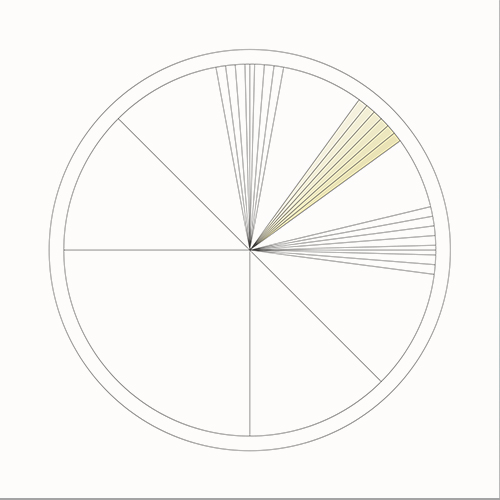
The Drumbulg Calendar | Work in Progress
This is a site-based temporal system integrating solar, lunar, and seasonal cycles to map ecological change over time. Functioning as both research framework and a generative structure for sculptural installation, it draws on pre-Cartesian cosmologies to treat time as relational and ecological, materially entangled with land, water, and long-term observation.
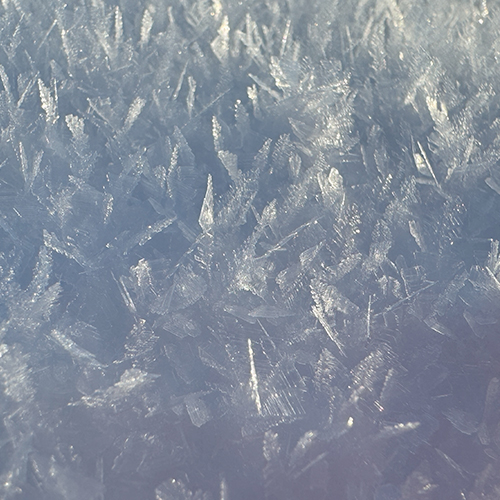
Drumbulg Water Cycle | Work in Progress
This is a site-based investigation tracing water as a material, ecological, and temporal system. Through hydrological mapping, observation, and land-based intervention, it examines rainfall, flow, storage, and return, treating water as an active agent linking climate change, infrastructure, memory, and long-term ecological resilience.
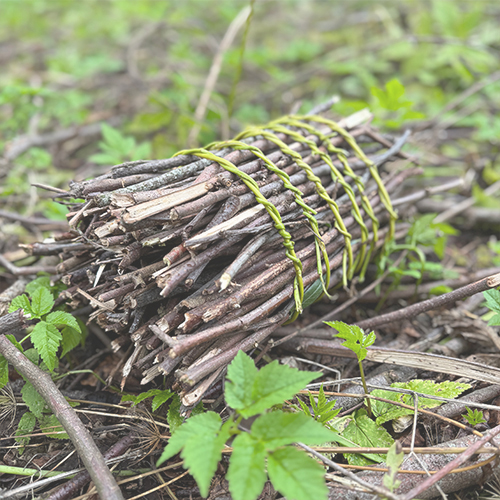
The Commons | Work In Progress
This ongoing work reanimates the “faggot” as fuel-bundle and as emblem of estovers, once-legal rights to gather from the commons. Performed daily at Drumbulg, each binding becomes a ritual act of attention: mourning lost relations to land while cultivating polytemporal practices that acknowledge excluded histories, climate grief, and the possibility of reparative ecological relation.
Drumbulg Material Practice is a site-based programme of situated material inquiry into how artistic and architectural materials can be developed, sourced, and evaluated in relation to land, seasonality, and ecological limits. Informed by material studies, craft knowledge, and regenerative design, it combines foraging, processing, testing, and documentation to build a materials library that includes site-specific substances and externally sourced materials assessed for acceptability within regenerative practice. Current work focuses on seasonal inks derived from locally gathered foliage, developing repeatable recipes and basic performance notes, while establishing a decision framework to support future installations and the Drumbulg architecture project.
AN ECO-HAUNTOLOGY
An Eco-Hauntology is an immersive, site-responsive installation that reconstructs the atmospheric and material conditions of climate crisis through a simulation of the water-vapour feedback loop. Using site-sourced water, sound, moving image, and custom electronics, it refigures Derrida’s hauntology through ecological collapse, bringing scientific process, artistic form, and public testimony into a single environment. Climate data becomes spectral: not simply evidential, but haunting, compelling audiences to inhabit entangled temporalities of uncertainty, loss, and the fragile possibility of renewal.
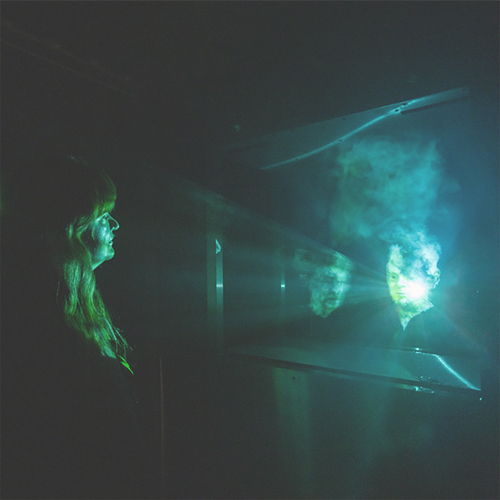
An Eco-Hauntology, installation view.
Site-responsive simulation of the water-vapour feedback loop, developed for Whitstable Biennale.
Photo: Rob Harris
RETURNING SHORES
Projected sea-level rise will soon restore Thanet’s insularity, once defined by the Wantsum Channel (UK). Through psychogeographic walking, recorded dialogue, photography and performative cartography, this work treats coastlines as thresholds where past and future fold into one another. Place-names recalling submerged shores function as archival premonitions. By marking anticipated sea levels, Returning Shores interrogates climate justice and displacement, situating local memory within planetary temporalities of crisis, submergence and return.
This Beach Will Be Closed
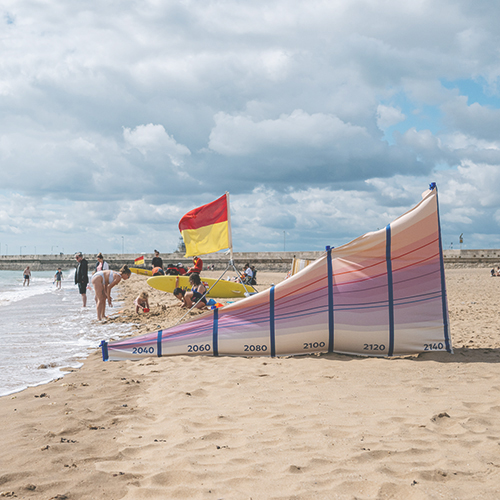
Installed along Thanet’s shoreline, this large-scale intervention translated NASA’s sea-level rise data into a physical windbreak, marking the projected disappearance of beaches within the next century. Developed by five artists, the project tested methodologies of listening, activism and public engagement, exploring how climate data might be made tangible. Here, speculation, cartography and collective memory intersected in a fragile topography of anticipated loss.
Photo by Matthew Kaltenborn
BEING (NON)HUMAN
Situated on the Isle of Grain, this collaborative work reconfigures a site of industrial infrastructure and estuarine fragility as a laboratory for multispecies perception. Combining psychogeographic walking, sonic composition and environmental data, it produces an immersive cartography that unsettles anthropocentric frames. By attending to thresholds where industry and ecology interlace, Being (Non)Human explores how art can generate alternative modes of sensing and inhabiting landscapes under pressure.
LV21
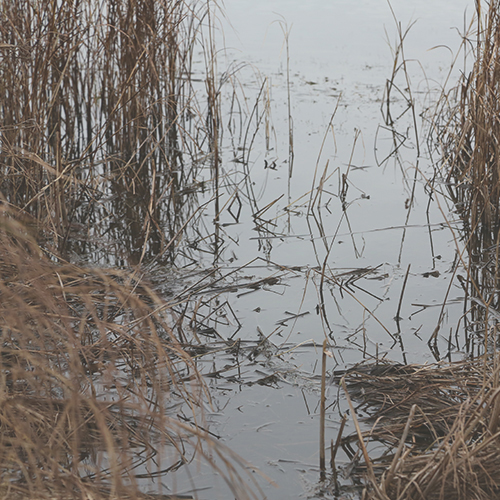
Installed on Light Vessel 21 for the Being Human Festival, this iteration transformed the ship into a site of multispecies encounter. Film projections of estuarine ecologies were interlaced with an immersive soundscape, aligning the vessel’s submerged spaces with non-human voices. Reconfiguring industrial infrastructure as sensorial archive, the work foregrounded entangled relations at the Isle of Grain.
HEALING EARTH
This body of work revisits Terra Lemnia, a pharmakon ritually harvested on Lemnos (Greece) and legitimised through ceremony. Retracing Galen’s journey to the historic seam, Healing Earth interrogates how ritual, geology and medicine once converged. By aligning ancient protocols of extraction with contemporary laboratory practice, it reframes earth as both symbolic and biomedical resource, linking archaic pharmacopeias with current soil research into antimicrobial peptides and microbial entanglements.
Terra Sigillata | Work In Progress
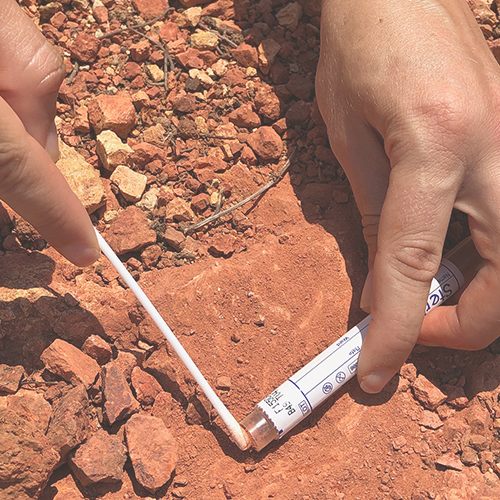
This work revisits Lemnos’ annual ritual where a priestess consecrated clay by lifting it overhead, then washed it through troughs before shaping stamped tablets (sphragides). I explore how these Pre-Cartesian rites of purification and authorisation anticipate laboratory protocols of sampling, filtering and provenance, reframing earth as both ritual and biomedical material.
THERIAK
Revisiting the legendary panacea of more than sixty ingredients, this work reimagines theriac through contemporary biotechnology and artistic research. Developed in dialogue with scientists, philosophers and historians, Theriak interrogates the entanglement of myth, medicine and ecology. By reactivating an ancient remedy as molecular experiment and cultural speculation, it unsettles biomedical authority and foregrounds pre-Cartesian epistemologies, situating healing within the shared metabolism of land, body and knowledge.
THERIAK Peptide
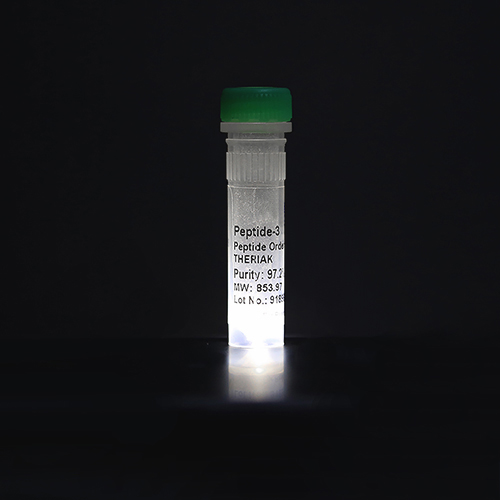
Synthesised during my residency at ETH Zurich, this de novo peptide was the first designed explicitly as an artwork. Spelling “THERIAK” through its amino acids, it reactivates the ancient panacea at a molecular scale. Neither cure nor commodity, it exposes healing as symbolic, cultural and biochemical entanglement, positioning art within the generative space of invention.
BIOLOGICAL HERMENEUTICS
This work reimagines the archive as a living site where microbial, material and cultural histories converge. Centred on a 300-year-old edition of Ovid’s Metamorphoses, it uncovers biological traces that disturb conventional notions of preservation. Across its iterations, Biological Hermeneutics demonstrates how human knowledge is enmeshed with other species and temporalities, contributing to discourses of posthumanism, material ecocriticism and the epistemic reorientation of the archive.
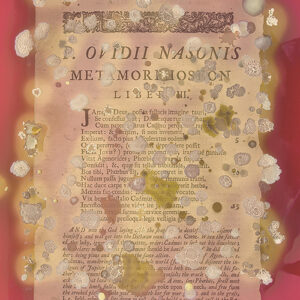
The Metamorphoses Chapter
These prints translate Book III into a microbial landscape by mapping bacterial colonies cultured directly from all 29 pages. Treating the book as both archive and laboratory, the work reveals how biological trace, material history and reading practices co-produce knowledge across biological, archival and cultural systems.